Playing with Fire: How a Trader Risks $100,000 Every Day on the Absence of War Between the U.S. and Iran
Playing with Fire: How a Trader Risks $100,000 Every Day on the Absence of War Between the U.S. and Iran
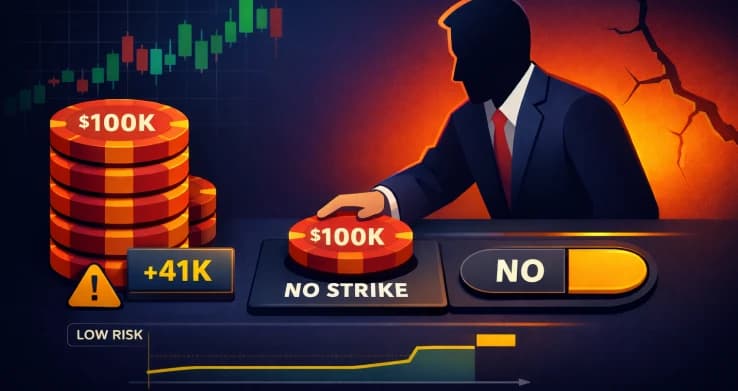
A trader has appeared on the Polymarket prediction platform who has chosen an extremely unusual and, at first glance, “safe” strategy. Every day, he allocates around $100,000 to the same event—a prediction that within the next 24 hours the United States will not carry out a military strike on Iran.
The approach seems simple: the bet is placed on the most likely outcome. As long as the world avoids escalation, the player steadily locks in profits. At the moment, he has managed to earn about $41,000 in net income. The return on a single trade ranges between 1–10%—modest, but quite tangible given such volumes.
Essentially, the trader is betting on the status quo: if the geopolitical situation remains calm, he earns his percentage and repeats the operation the next day.
Why These Bets Look “Almost Guaranteed”
Prediction platforms have long become part of the crypto industry. On Polymarket, you can find dozens of markets tied to events that, at first glance, seem extremely unlikely: sudden political decisions, abrupt military actions, or unexpected resignations of leaders.
Many users use such markets as a tool for “slow farming”—small profits on highly probable outcomes, repeated day after day. This resembles a conservative trading strategy, where the main goal is stability rather than aggressive growth.
But this is exactly where the main trap lies.
“Picking Up Coins in Front of a Steamroller”: Where the Real Risk Is Hidden
This type of model is known in financial markets as the strategy of “picking up coins in front of a speeding steamroller.” You regularly collect small profits—until one day the steamroller runs you over.
In this case, the “steamroller” is a sudden geopolitical escalation. One real military strike—and the entire daily $100,000 stake burns instantly. With returns of 1–2% per trade, it would take dozens or even hundreds of consecutive successful days to compensate for a single failure.
And under conditions of global instability, guaranteeing the absence of force majeure is impossible.
The Illusion of Control and the Psychological Factor
From a psychological perspective, the strategy appears reasonable: the probability of a peaceful outcome today is indeed higher than the probability of war breaking out. The player feels in control of the situation—after all, he is betting not on something exotic, but on “normality.”
However, prediction markets, like any speculative instruments, do not forgive single but large mistakes. In such models, profit accumulates slowly, while losses arrive suddenly and without warning.
The trader has already earned $41,000. But the real question is different: will he be able to stop in time? Or will greed and the illusion of stability lead to the loss of the entire hundred thousand in a single day?
Conclusion: The Strategy Works—As Long as It Works
Earning money on geopolitics through platforms like Polymarket is indeed possible. But this model is not about long-term sustainability—it is about discipline and timely exit.
As long as the world remains in relative balance, the strategy generates income. But once the situation slips out of control, all accumulated profit can disappear in a second.
Sometimes the most dangerous risk is the one that seems minimal.

 Te5Ka555Mar 4, 2026Math is against him. Sooner or later geopolitics will fail, and he’ll be down a hundred grand.
 KIIhunHoHnMar 5, 2026The scale is insane… I hesitate over $100, while someone else is spinning hundreds of thousands.
 GaeBaeryMar 7, 2026He’s essentially selling fear of war. As long as it doesn’t happen, he makes money. An interesting model.